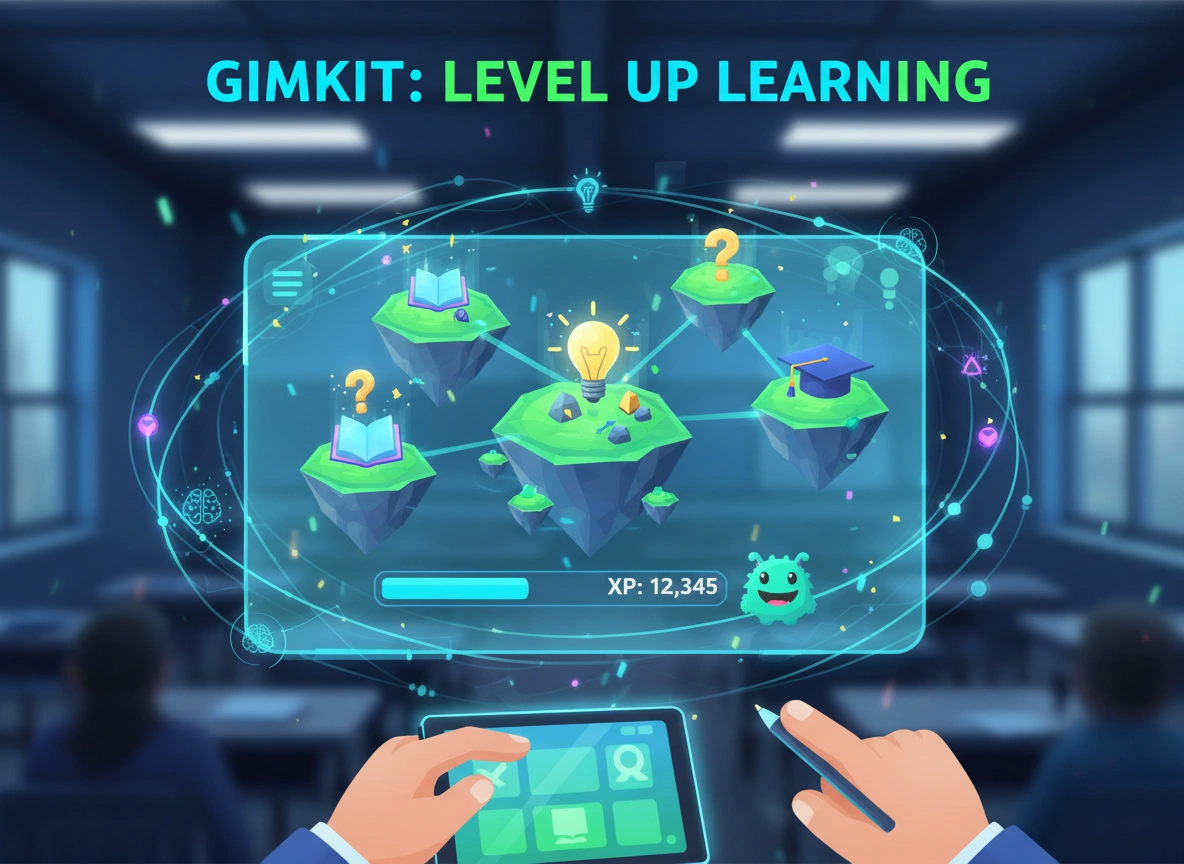
Traditional teaching methods often struggle to compete with the instant gratification and high-engagement loops found in video games. For decades, educators have looked for ways to bridge this gap. Enter gamification: the application of game-design elements in non-game contexts. Among the various tools available, Gimkit has emerged as a standout platform that doesn’t just “gamify” a quiz but fundamentally changes the psychological landscape of the classroom.
Gimkit isn’t merely a digital worksheet; it is a sophisticated engagement engine built on solid psychological principles. By understanding why it works, educators can leverage it not just for review days, but as a powerful pedagogical tool that taps into intrinsic motivation, risk-reward assessment, and flow states.
The Core Principles of Educational Gamification
Gamification in education is often misunderstood as simply adding points or badges to a lesson. However, effective gamification goes deeper. It aligns the learning objectives with the psychological drives that make games so compelling.
Immediate Feedback Loops
In a traditional classroom setting, a student might hand in a worksheet and wait days for a grade. This delay disconnects the action (answering a question) from the consequence (learning from a mistake or being validated). Video games offer immediate feedback. If you jump too early, you fall. If you aim correctly, you score.
Gimkit replicates this immediacy. When a student answers a question, they know instantly if they were right or wrong. If they are right, their in-game currency increases immediately. This tight feedback loop reinforces learning pathways in the brain. The dopamine release associated with the “win” (earning money) cements the correct answer in memory more effectively than a red checkmark received three days later.
Autonomy and Agency
Self-Determination Theory (SDT) suggests that autonomy is a critical component of motivation. Traditional schooling often strips students of agency; they are told what to learn, when to learn it, and how to demonstrate that learning.
Gimkit restores agency through its unique economy. Students choose how to spend their earned currency. Do they invest in upgrades to earn more money per question? Do they buy insurance to protect against penalties? Do they purchase power-ups to sabotage the leader or boost their team? These micro-decisions force students to strategize. They aren’t just answering history questions; they are managing resources and making autonomous choices that affect their outcome. This shift from passive recipient to active strategist is crucial for engagement.
How Gimkit Leverages “Loss Aversion” and Risk
One of the most fascinating psychological elements of Gimkit is its handling of risk. Behavioral economists Daniel Kahneman and Amos Tversky identified “loss aversion,” the idea that the pain of losing is psychologically about twice as powerful as the pleasure of gaining.
In many educational games, a wrong answer just means you get zero points. In Gimkit, a wrong answer can cost you money. This introduces stakes. When a student builds up a significant bank balance, the fear of losing it forces them to slow down and verify their answers. They stop guessing and start thinking.
The Strategy of “High Stakes” Learning
This mechanic teaches students to calibrate their confidence. If they aren’t sure of an answer, the psychological cost of guessing is high. This encourages them to use resources (like looking up notes or asking a peer) before committing to an answer. It transforms a quiz from a test of memory into an exercise in metacognition—thinking about their own thinking.
However, Gimkit balances this with the opportunity for redemption. Unlike a test where a bad grade is final, Gimkit allows students to earn their money back quickly through streaks and upgrades. This resilience-building feature shows students that failure is temporary and recoverable, a key tenet of a “growth mindset.”
The Flow State in the Classroom
Psychologist Mihaly Csikszentmihalyi coined the term “flow” to describe a state of complete immersion in an activity. To achieve flow, a task must strike a balance: it cannot be too easy (leading to boredom) or too difficult (leading to anxiety).
Gimkit creates an environment ripe for flow states through its adaptive mechanics.
- Repetition without Boredom: Students see the same questions multiple times. As they memorize the answers, their speed increases, and their earnings skyrocket. The task evolves from “learning the content” to “optimizing income,” keeping the challenge fresh even as the content becomes familiar.
- Dynamic Difficulty: As students purchase upgrades, the game speeds up. They earn more, but the stakes get higher. This scaling difficulty keeps students in the “flow channel,” ensuring they remain engaged from the first minute to the last.
Social Psychology and Cooperative Competition
Humans are inherently social creatures, and peer interaction is a powerful motivator. Gimkit leverages this through its various game modes, particularly “Team Mode” and “Trust No One” (an Among Us-style social deduction mode).
Collaborative Accountability
In team modes, individual performance contributes to a collective goal. This taps into social accountability. Students who might not care about their own score often work harder because they don’t want to let their team down. This phenomenon, known as the “Köhler Effect,” suggests that weaker group members will exert more effort when working in a team than they would alone, specifically to avoid being the “weak link.”
The Power of Sabotage
Standard Gimkit modes allow students to use power-ups to “freeze” or subtract money from other players. While this sounds antagonistic, it adds a layer of social playfulness. It keeps the leaderboard dynamic. The student at the top cannot become complacent because they are a target. The student at the bottom remains engaged because they have the power to disrupt the leader. This “crabs in a bucket” mechanic ensures that the game remains competitive and exciting for everyone, regardless of their academic proficiency.
Why This Matters for Educators: Beyond the Game
Understanding the psychology behind Gimkit allows teachers to use it more effectively. It shifts the perspective from “playing a game” to “practicing cognitive skills.”
Breaking the Anxiety Barrier
For many students, assessments induce high levels of cortisol, the stress hormone that inhibits the brain’s ability to retrieve information. By framing assessment as a low-stakes game with high-engagement mechanics, Gimkit lowers the affective filter. Students are less anxious about being wrong because the context is playful. When anxiety drops, the brain’s capacity for learning and retention increases.
Differentiated Learning Paths
Because students control their own upgrades and strategy, Gimkit naturally differentiates instruction. Advanced students might focus on high-risk, high-reward strategies and rapid recall. Students who need more time can focus on steady accumulation and “insurance” upgrades to protect their progress. The game meets the student where they are, allowing diverse learners to participate in the same activity meaningfully.
Data-Driven Instruction
While students are caught up in the psychology of the game, the teacher receives valuable data. Gimkit provides detailed reports on which questions were missed most frequently. This allows for immediate intervention. A teacher can look at the post-game report, see that 60% of the class missed the question about photosynthesis, and address it instantly while the memory of the game is still fresh.
Practical Applications for the Classroom
To maximize the psychological benefits of Gimkit, educators should vary how they use it:
- The Pre-Assessment (Low Stakes): Use it before teaching a unit to gauge prior knowledge. The game mechanics keep students from feeling discouraged by what they don’t know yet.
- The “kit” as Homework: Assigning a Gimkit as homework (using the assignment feature) allows students to practice at their own pace, utilizing the repetition to reach mastery without the pressure of a live timer.
- Student-Created Kits: Ask students to create their own questions. This moves them up Bloom’s Taxonomy from “remembering” to “creating,” forcing them to understand the material well enough to formulate wrong answers (distractors) that are plausible.
Conclusion
Gimkit works not because it is flashy, but because it is psychologically sound. It satisfies the human need for autonomy, competence, and relatedness. It transforms the often-solitary act of memorization into a social, strategic, and emotionally engaging experience. By leveraging principles like immediate feedback, loss aversion, and flow, Gimkit does more than make learning fun—it makes learning stick. For educators, recognizing these underlying mechanisms is the key to transforming a simple game into a profound learning strategy.
Please visit website for more info